
Is My Food Footprint Compliant? A look at the race to standardize food LCAs

Who wants to talk about compliance and regulations? It's dry, complicated, and often you need a couple of consultants just to tell you what it's generally about. At Niatsu we have been building food LCAs according to ISO 14040/44 for years, and still, when a partner asks me what ISO 14040/44 really means, I struggle. The reason is simple: at the end of the day, you cannot compare one LCA done according to ISO 14040/44 with another. That gap has triggered several efforts to standardize the methodology of food LCAs, and I thought an overview might be helpful for you.
The need for a standard, and why it’s complicated
As of August 2026, there is no single agreed framework across Europe for assessing the footprint of a food product. Many providers and consultants will offer to calculate an impact, but comparing their results with each other is tricky. When we started building Niatsu, what to follow and where the field would move was a big discussion. Today I can tell you: it's complicated.
ISO 14040/44 was originally developed as a guideline and compliance standard for Life Cycle Assessments. That was back in 2006, when the first LCA databases like Ecoinvent and GaBi started to gain a bigger presence. ISO 14040/44 was intended to provide a framework of assurance, a set of rules and boundaries for how an LCA had to be conducted. To this day, it remains the default framework for conducting LCAs. The GHG Protocol later built product-level guidance on the same foundation, and ISO 14067 followed in 2018 for the carbon footprint of products.
The issue for food is that these frameworks allow for a lot of flexibility, and depending on the application (producer, wholesale, retail or consumer), different aspects gain in importance. Nobody argues against a standard: it would raise quality and speed up industry adoption of environmental footprints. But there is a lot of politics and power involved in who gets to set the framework and who builds the next standard.
Databases and Methodologies
At Niatsu we are building both a new kind of LCA database for food and a fully automated LCA platform, so we had to set our own rules for how to conduct an LCA to our standards, still following ISO 14040/44.
Here is my quick analysis of why everyone is trying and nobody has fully succeeded. In the end, everyone wants the same thing: a product carbon footprint that is accurate, compliant and reliable. A footprint that won't change in the future and that you can build reduction and reporting strategies on. In reality, there is no publicly available LCA database that covers all the ingredients and processes a food item entails.
This means that no matter how detailed you model your food item, the matching to LCA inventories still has to be done, and it is to some extent arbitrary: one person would match some things differently than another. At Niatsu we operate our own machine learning models for this, and although they are very accurate (over 95%), we retrain them from time to time, and some things end up interpreted differently. There will never be a deterministic process where everything is done exactly the same every time.
That covers the database challenge. Whether you use Ecoinvent, Agri-footprint, WFLDB or Niatsu, footprints will be matched differently even if everyone chooses the same database. And what we see in reality is more of a wild mix of different sources.
Which brings me to the process of modelling the product itself. Here, more standardization efforts are underway, but their success depends entirely on adoption: will industry, politics, NGOs and providers agree or not? Let me show you some of the ongoing efforts.
European Sustainable Food Coalition
Niatsu is a member of the ESFC, which brings together providers, policy stakeholders and operators. The ESFC contributes its knowledge to different initiatives, such as creating clearer frameworks around the European EmpCo Directive and supporting the European Commission on the Product Environmental Footprint (PEF) standards. The challenge we have experienced so far: it is tricky to align different stakeholders without a clear regulatory push and in general there is a lack of funding for such work.
Mondra Coalition
The Mondra Coalition brought together operators in the UK and worked out one of the first European national standards for how LCAs have to be done to be comparable between operators. If you sell into UK retail, this is the standard you will sooner or later be measured against.
The methodology is comprehensive but still allows for quite a lot of flexibility, starting with the selection of the database and extending to what is mandatory and what is not for each item. Reading it reminds me a lot of ISO 14067, just with more detail and nomenclature around food. The more interesting signal is the direction: a national market agreeing on one set of rules, publicly available, updated version by version.
Global Sustainability Transition Alliance
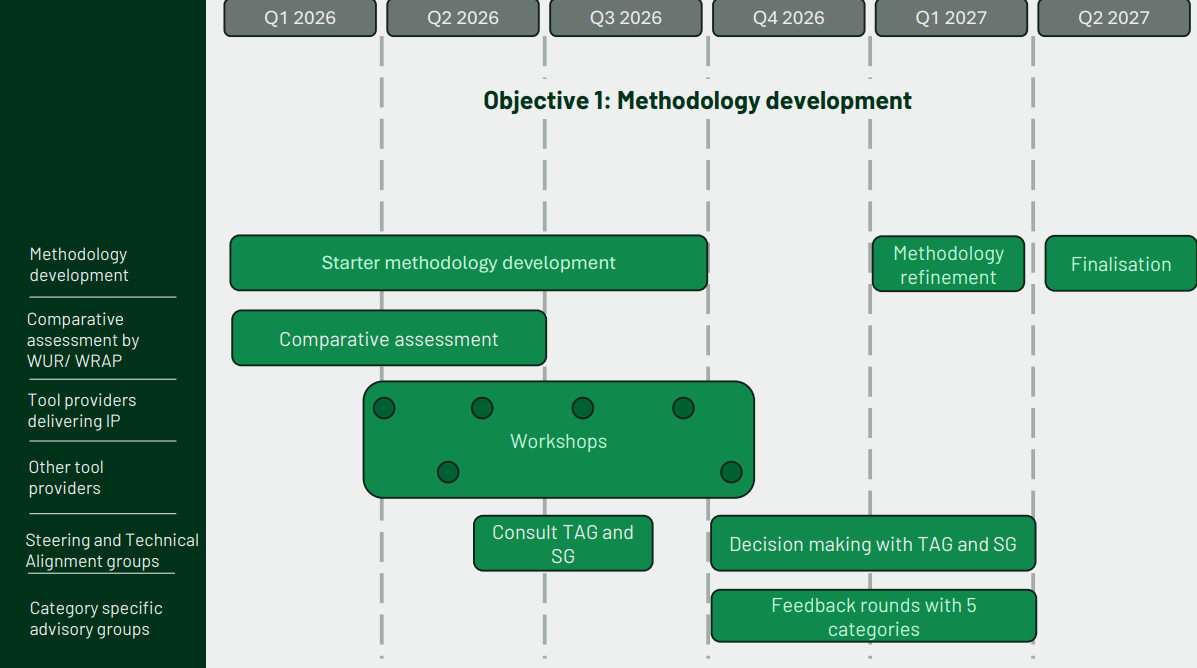
The newest coalition GSTA, founded by WRAP and Wageningen University and Research. It is probably the biggest effort so far to bring stakeholders together across Europe. The goal is to create both an aligned methodology and an emissions database, and solve the challenge once and for all. The original timeline is shown below.
Ecolabel aka Affichage Environnemental
While coalitions are still aligning stakeholders, France simply went ahead and regulated. The affichage environnemental has its legal basis in the Climate and Resilience Law of 2021 and is run by ADEME, the French environment agency. Instead of waiting for the industry to agree on a database and a methodology, France mandated both: Agribalyse as the reference database for agricultural and food products, and Ecobalyse as the official calculation tool.
Where does it stand today? The expected path follows the textile sector, which went first: consultation, notification to the European Commission, then the application texts. Display remains voluntary for now, but adoption is already happening. E.Leclerc rolled out the score on 6,000 products in April 2026, ahead of any legal obligation, with a broader rollout planned in stages across 2026 and 2027. In parallel, the EU-funded Eco Food Choice project is working on harmonizing this approach across Europe, with a final methodology expected in November 2026.
So, is my food footprint compliant?
The honest answer in August 2026 is: compliant with what? If your LCA follows ISO 14040/44, you are compliant with the only framework that is universally recognized. And at the same time, you now know that this alone does not make your footprint comparable to anyone else's.
Our approach has been that the compliance part will find its way eventually. Until then, the focus should be on action. The perfect footprint doesn't exist, but if you follow one methodology such as Niatsu's across all of your products, you can make decisions and identify hotspots today.
Finally, ask your provider for in-depth documentation and sources, and let them explain their methodology to you. We quite often find previous work, for example from consulting companies, that is far away from any standard LCA methodology or robust framework.