
How to Assess the Environmental Footprint of Food Transport

You shouldn't eat food from overseas, right? It's bad for the environment, is it? My friends occasionally make fun of me, because at Niatsu we are working on a very data-heavy technical challenge: understanding the impact of food globally. And transportation is, in the public mind, often considered one of the things with a big impact. I think this originates from CO2-equivalents often being compared to a distance driven by car, because that's what humans can understand. Today I want to show you why the topic of transportation is a lot more nuanced in terms of carbon accounting, especially in food.
Let’s make one thing clear
If you go to your local farmers market, you shouldn't worry about transport emissions. They are basically none. Local sourcing makes a lot of sense, except for the part where local means something different everywhere. In Germany a Bundesland might be considered local, in the United States it might be a state. I will not argue in this text that local sourcing is a bad thing, I just want to clarify that just because something was shipped around the globe, that might not be the crucial part of the impact.
Here is the number that surprises most people: across all the food we eat, transport makes up only a few percent of the total footprint. For beef it's often less one percent. What you eat matters far more than how far it traveled.
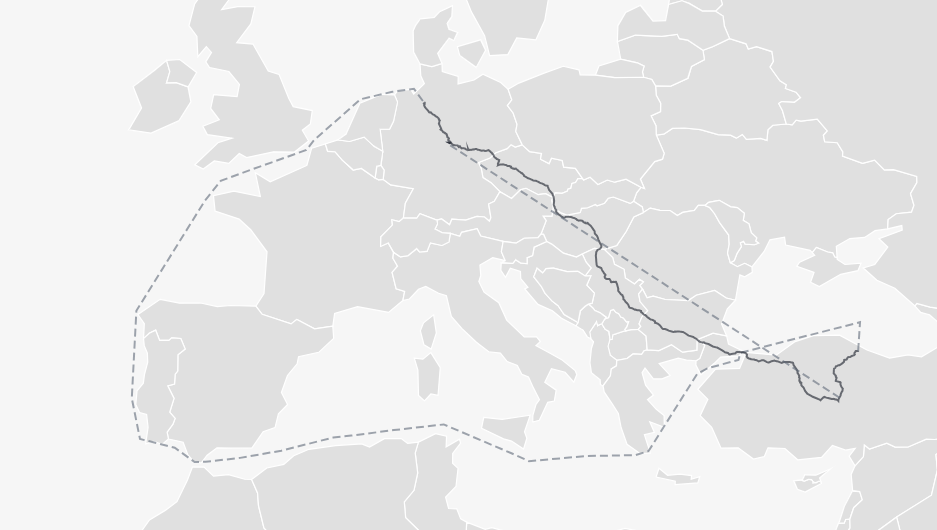
Nuts from Türkiye
Let's use Niatsu to make a quick example for transporting nuts from Türkiye to Germany. If we take the plane, it takes around 3.59 kgCO2e to transport 1 kg of nuts. If we ride the whole distance by truck, we will use around 0.95 kgCO2e for the journey. Finally, if we take the ship and include a transport to the nearest port by truck both in Türkiye and Germany, we end up with emissions of 0.33 kgCO2e, where the distances covered by truck have higher emissions than the over 7,000 km we cover by ship.
For context: growing the nuts themselves usually causes more emissions in the orchard than the entire journey by ship. The ship is almost a rounding error. The plane is not. This example illustrates something simple: as long as food is transported by ship, transport is rarely the problem.
A simple formula to keep in your head
If you want to remember one thing from this post, make it this:
Transport emissions = how much you ship × how far × what vehicle
Ships are extremely clean per kilogram, planes are extremely dirty, trucks are somewhere in between. Distance matters much less than people think, because the mode can differ by a factor of 100. And the first part, how much you ship, is where things get interesting.
Supply chain matters
The Türkiye example is nice because it's easy and represents the situation if we look at a raw commodity being shipped around the world. Another example, which we discussed for a while with a partner because it illustrates supply chain complexity, is dried onions. In this case the company produces dried onions in Germany. They either source the onions locally or import them from India. Because it takes around 8.23 kilograms of fresh onions to produce 1 kilogram of dried onions, they have to ship 8.23 kilograms from India to Europe. The emissions from this transport end up at 4.84 kgCO2e per kilogram of dried onions. Compared to the near-zero emissions from sourcing locally, that's a huge difference in the emission factor.
Notice what's actually going on here: it's not the distance that hurts, it's the water. They are shipping 8.23 kilograms to sell one. If the onions were dried in India first and shipped afterwards, the transport emissions would drop to roughly an eighth. Processing close to the field and shipping the light version is one of the cheapest emission reductions there is.
How do you calculate the footprint of transport?
First, you need some supplier data, or data from your own supply chain. Second, realistic transport routes have to be considered. It doesn't matter to include every detail, and in general, if you look at a product carbon footprint, the famous last mile is not the most relevant one. At Niatsu we developed our own transport engine that calculates realistic shipping and road routes, so that we actually map your supply chain. This route is then connected with an emission factor.
Transportemissions per 1000 Kilometers for 1 Kilogram of Product
0.0
gCO2e/1000km
🚢 Ship
0.0
gCO2e/1000km
🚆 Train
0.0
gCO2e/1000km
🚛 Truck
0.0
gCO2e/1000km
✈️ Plane
Which means of transport should you choose?
As a rule of thumb, flying food is bad. Most commonly, fish is flown in. Rarely also tropical fruits and vegetables. As long as you source locally, the means of transport doesn't matter in the bigger picture. Within Europe, rail is more sustainable than transport by lorries, although new and more efficient technologies might change the numbers in your case. One thing to keep an eye on: refrigerated transport adds a real premium, so chilled and frozen products carry more transport emissions than the distance alone would suggest. For overseas products, the ship is your best option and it doesn't automatically mean that potatoes from abroad have a significantly worse footprint just because they traveled a long distance.
If you work with food and want to know whether transport is one of your corners where it matters, three questions get you surprisingly far: Is anything in your portfolio flown in? Are you importing heavy ingredients that get processed down after arrival? And do you actually know how your goods travel? If you are unsure: that's exactly the kind of thing we built Niatsu to figure out.