
Do Avocados have a high carbon footprint?

If your friend is making you feel guilty because you have been eating a lot of Avocados lately, you might be wondering whether Avocados are good for the planet?
According to our own data, the average footprint of an Avocado is around 1.2 kgCO2e per kilogram of Avocado at farm gate. This is higher than other fruits and vegetables like potatoes and apples but still significantly lower than most animal products.
However, if we want to be more precise, we need to first understand where Avocados normally are grown and what supply chains look like. And this is where things get a little bit complicated.
Where do Avocados grow?
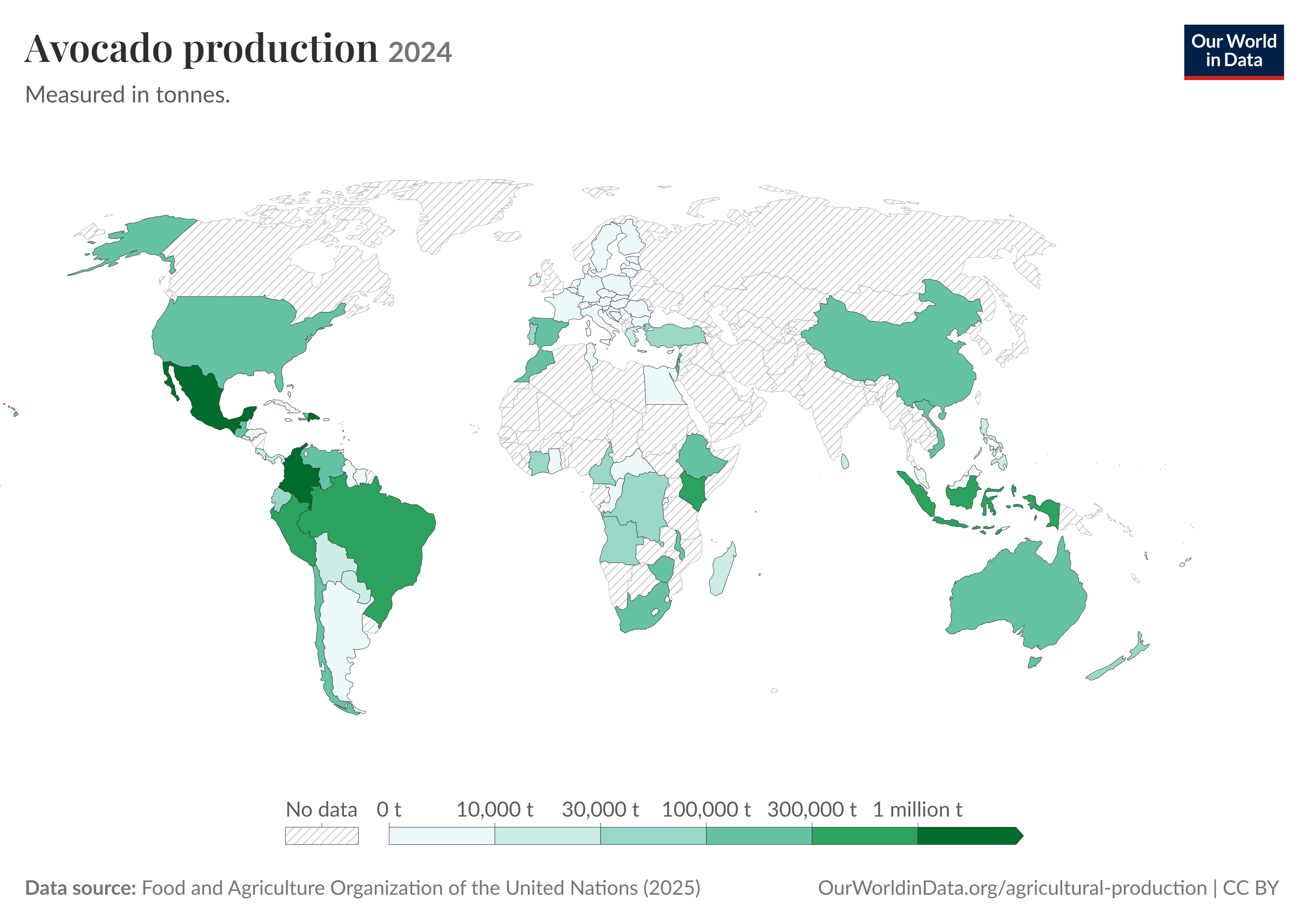
Mexico, Colombia and the Dominican Republic are some of the biggest producers in the World. In Europe some production started in Portugal, Spain and Morocco but compared to the bigger producers in way smaller numbers.
Do the emissions from the transport matter?
For a recent news article we ran some numbers for Switzerland. What happens if we compare an Avocado from Peru (transported by boat) and an Avocado from Peru (transported by plane) with an Avocado from Spain (transported by truck to Switzerland)?
Comparison of Different Avocados consumed in Switzerland
0.0
kgCO2e/kg
Avocado from Peru (transported by boat)
0.0
kgCO2e/kg
Avocado from Peru (transported by plane)
0.0
kgCO2e/kg
Avocado from Spain (transported by truck)
Our data says that the highest emissions by far are from the Avocado transported by plane with 16.328 kgCO2e per kilogram of Avocado. The avocado by boat emits 3.133 kgCO2e per kilogram of food and the avocado from Spain sits at 1.75 kgCO2e.
In summary the Avocados from Spain and Peru have slightly different agricultural emissions but the transport by boat or truck is negligible. The only thing that really matters is if an Avocado is flown to its consumption destination.
What is causing the emissions in Avocados?
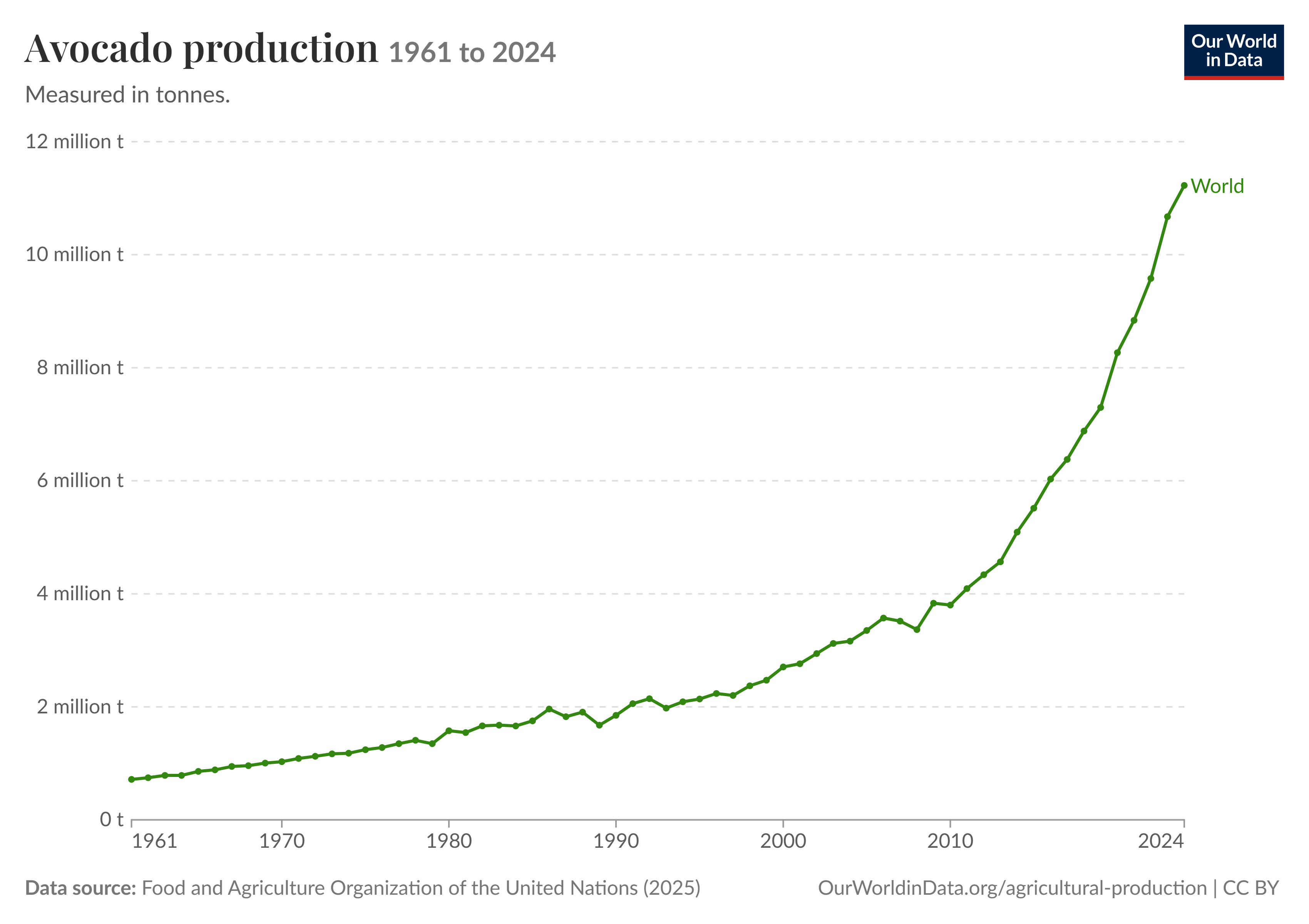
As global Avocado production continues to increase, more and more areas are converted in avocado farms. This causes land use change which is a significant driver of Avocados emissions. It means that areas that before were forest are transformed into avocado orchards. As part of this change to the environment cover crops are lost, which has big impacts on availability of water. Cover crops help to keep the water in the ground when it rains, and letting it go, when there is not enough.
How much water does an Avocado actually need?
On average an Avocado takes around 70 liters of water to grow. That sounds like a lot for one fruit, and it is, but it is not unusual for a fruit tree and it is not the interesting number.
The interesting number is what happens when you look at a specific region instead of the average. In the Valparaíso region in Chile the same Avocado has been estimated at around 320 liters, because it grows on dry hillsides in an area that has been in drought for years. In the Petorca valley the plantations grew from roughly 2,000 hectares in the late 1990s to over 16,000 by 2019, while some residents were at times supplied with 50 liters per person and day by tanker truck for their whole household.
But it shows the limit of a carbon number. A liter of water in Germany and a liter of water in Petorca are the same liter in our database and completely different things in reality. Water scarcity is local in a way carbon is not, which is why the footprint alone never answers the whole question.
So should you feel guilty?
Back to your friend. An Avocado weighs around 200 grams, so at our average that is roughly 0.25 kgCO2e for the whole fruit. A 200 gram beef steak is somewhere between 10 and 20 kgCO2e. You would have to eat an Avocado every day for months to catch up with one steak dinner.
So on carbon your friend picked the wrong target. What you eat matters far more than where it came from.
If you want a rule that does something: Check the origin. Spain, Portugal, Morocco arrive overland or on short routes. Peru, Chile and South Africa arrive by ship, which is fine.