
Pizza is not just pizza: Why CO2 categories are dangerously inaccurate

Many retailers and manufacturers calculate their Scope 3 emissions based on product categories. A pizza falls into the category of «ready meals» and gets assigned an average value. Sounds pragmatic. But it is not. It is simply inaccurate.
The category problem: Apples, oranges and frozen pizza in the same bucket
The «ready meals» category is one of the most imprecise in the entire food industry. It groups together pasta with tomato sauce, a product with very low CO2 emissions dominated by plant-based ingredients, and frozen pizza with salami and cheese, a product with a significantly higher footprint driven by animal products.
The average value for this category is wrong for both products. Too high for one, too low for the other. Anyone building a climate strategy on this basis is not making a single well-founded decision, but calculating with a number that systematically distorts reality.
And even when going one level deeper and looking only at frozen pizzas: the problem does not disappear. It just becomes slightly less visible. And that is exactly what this article is about.
Two pizzas. Same category. 29% difference.
Two products from the Swiss food retail market, sitting side by side on the shelf and belonging to the same product group in the eyes of the consumer:
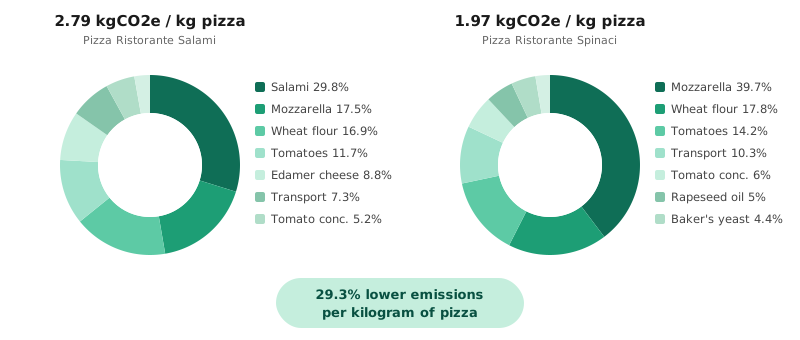
Pizza Ristorante Salami: 2.79 kgCO2e / kg pizza
Pizza Ristorante Spinaci: 1.97 kgCO2e / kg pizza
That is a difference of 29.3%, for two products of the same brand, the same format, the same refrigerated shelf.
Why? The answer lies in the ingredients
A look at the emission sources explains the difference immediately.
For the salami pizza, the two largest drivers are salami at 29.8% of total emissions and mozzarella at 17.5%. Together, two animal-based ingredients account for almost half of the product's entire CO2 footprint.
For the spinaci pizza, the salami is absent entirely. The mozzarella remains and at 39.7% is the single largest driver. But without salami as a second major emitter, the overall value drops significantly.
The wheat flour, the tomatoes, the transport are comparable for both pizzas. The difference arises solely from the composition of the ingredients.
What this means in practice
When category data is used, the salami pizza and the spinaci pizza receive the same CO2 value. Improvements through recipe optimisation are invisible. Emission-intensive products do not appear as areas for action. And a Scope 3 report built on this basis will not hold up to external scrutiny.
A 29% difference within a single product line is not a footnote. It is the difference between a well-founded climate strategy and a well-intentioned estimate.
The only path to real accuracy: product-based calculation
Not at category level, not at assortment level, but at product level, based on the actual ingredients. For each product, the CO2 footprint is calculated on the basis of its real composition. This creates comparability within a category, makes levers visible and delivers numbers that hold up to scrutiny.
Pizza is not just pizza. And a reliable CO2 balance should reflect that.